Compile the Boundary, Not the Judgment
Software's advantage is not perfect formalism. It is cheap feedback over explicit properties. Knowledge-work systems need the same discipline without pretending judgment can be compiled away.
Design Technologist,
AI Infrastructure,
Prototyping.
Software's advantage is not perfect formalism. It is cheap feedback over explicit properties. Knowledge-work systems need the same discipline without pretending judgment can be compiled away.
An architectural deep-dive into Google's open agent orchestrator AX, why it runs on Redis Streams instead of Kubernetes etcd, and the gap between agent hypervisors and cognitive workflow engines.
A response to Katelyn Lesse's article on secure agents, and why outbound mediation is only useful when it enforces a broader authorization and information-flow model.
A response to Yoshua Bengio's post on agents lying, cheating, and coordinating: the failure is not that agents have human motives, but that we are giving proxy optimizers tools, time, and weak accountability.
A hiring-market note on why AI makes visible judgment, problem framing, and situated workflow artifacts more valuable than generic tool fluency.
A response to Eno Reyes' question about agent boundaries, and why I think the durable unit is the work container rather than the agent team.
What Amp's paved-road thesis and Truss Labs' prepared-work-item thesis reveal about Soul CLI, and why the next useful layer is a real case packet for agent work.
How I wired a jailbroken Kindle, KOReader, BookOrbit, and Tailscale into a small personal reading appliance, then tuned the KOReader plugins until it felt quiet enough to use.
A note on wiring Hermes, wallabag, and Soul together without turning every reading workflow into another chat transcript or another vault.
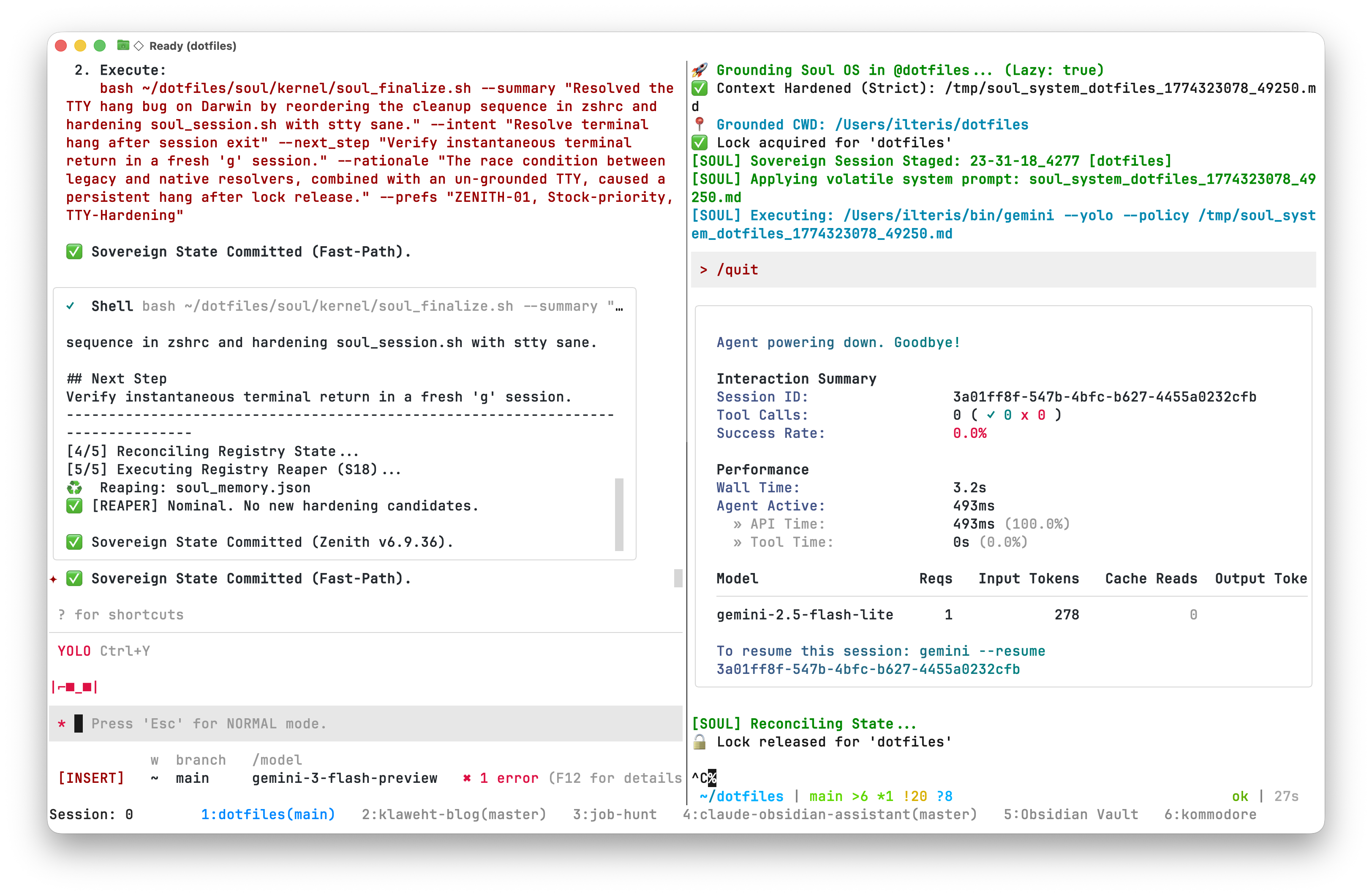
Why I added tasks, runs, worktrees, reviews, and plan-bound execution to Soul CLI, and how they turn AI-assisted development into an auditable local system.
Why Soul keeps registry coordination separate from git, and why remote continuity should mean projection plus promotion rather than distributed writes.
How I built a repeatable link-to-podcast pipeline that extracts a source, writes a spoken two-host script, generates audio, saves notes, and publishes an RSS episode to podcast apps.
How I built an automated, self-healing pipeline that generates a command-line reference directly from the active parser schema without manual translation.
How I structured my local agent environment using isolated execution surfaces, dedicated background runtimes, and a unified file-based session registry.
How I consolidated dozens of loose shell and Python scripts into a single, cohesive command-line tool to manage my agentic workspace.