Actor-Orchestrator: Agentic Swarm Infrastructure
This post was drafted with Gemini-3-flash to synthesize technical documentation and system architecture logs for the Actor-Orchestrator project. The final narrative, S5 Protocol definitions, and system diagrams were manually verified for technical accuracy.
Most people see AI as a chatbot. I see it as a distributed systems problem.
The Actor-Orchestrator is a “Unix-for-AI” architecture designed to manage concurrent, autonomous agent workstreams using gemini-cli and zmx. It moves beyond simple prompt-response loops into a robust, hierarchical system capable of executing complex, long-horizon tasks with high fidelity and total isolation.
The “Unix-for-AI” Philosophy
The core of this system is the belief that AI agents should operate like Unix processes: isolated, specialized, and steerable. By using the Actor Model pattern, we delegate tasks to isolated sub-agents (Workers) that operate in their own persistent terminal sessions. This prevents file-system conflicts, eliminates logical crosstalk, and ensures that every contribution is atomic and verifiable.
The Hierarchy of Intelligence
The system operates through three distinct layers:
- Meta-Orchestrator (Teddy): The high-level personal architect that bootstraps the environment and monitors the overall system trajectory.
- Supervisor Actor: The project manager that monitors the
.tasks/directory andTODO.mdblackboard. It delegates tasks via a deterministic dispatch engine. - Worker Actors: The distributed engineers. Each worker handles a specific task: Clone → Branch → Implement → Verify → Commit → Pull Request.
The S5 Protocol: Atomic Contribution
Every worker follows the S5 Protocol, a strict lifecycle designed for maximum reliability:
- Isolation: Every task runs in a dedicated branch (
task-<ID>-<slug>). - Hermetic Execution: Workers run in unique temporary workspaces.
- Local Verification: No code is committed without automated verification.
- Automated PRs: Pull requests are created via the GitHub CLI (
gh) and reported back to the master Command Center.
Swarm Command Center
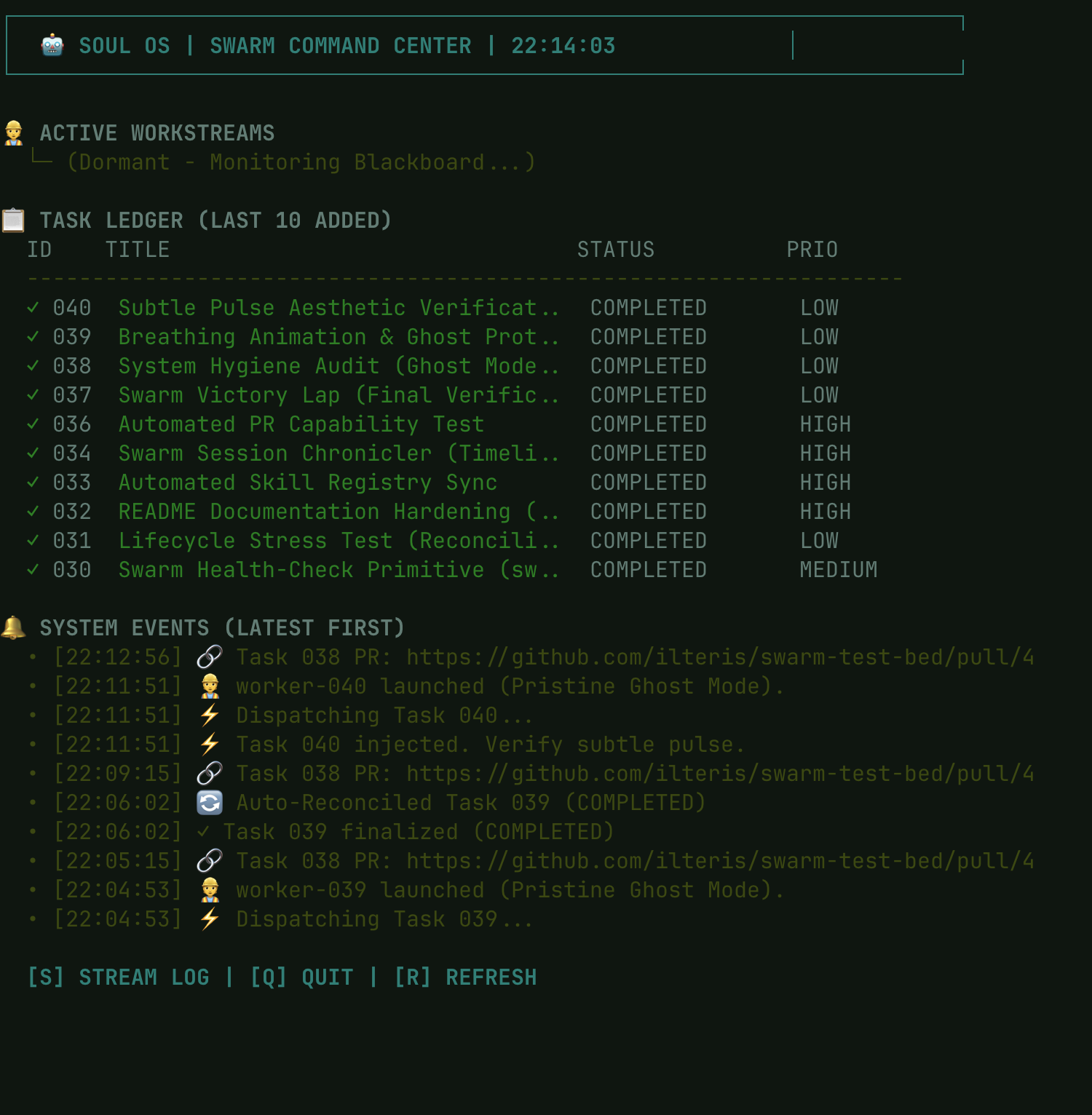
Observability is the bridge between autonomy and trust. The Swarm Command Center provides a high-fidelity TUI for real-time monitoring of the active swarm:
- Active Reasoning: Live previews of worker “thoughts” and pulsating heartbeats.
- Task Ledger: A sorted history of task states.
- System Events: A feed of automated PR detections and infrastructure events.
Vision: The Cognitive Multiplier
The Actor-Orchestrator is more than a tool; it’s a Cognitive Multiplier. By offloading high-throughput implementation to parallel agents while maintaining strict architectural oversight, we can reach production-ready states in days, not weeks.
Explore the source on GitHub: ilteris/actor-orchestrator