Networkedobjects Pcomp_Improv
- For our first week, Tom wanted us to create something engaging which shows our pcomp skills. -And refresh our memories possibly maybe. I started brainstorming and came up with the idea of transforming user interaction into visualization. As you not already know, I am kind of biased with the whole data visualization concept pretty much. So in order to do that, I thought of a scenario that is simple. -Let’s say doable in one week.
- This is a system that collects the ambient sound levels of a room, and probably of people and interprets them into bubbles through a processing application realtime. Not rocketscience, it is just something I pursue nowadays. Transformation of data.
- I divided the project in two half, one is physical side, and the other is software side. For the physical side, I will be needing a one transistor op-amp which will amplify the microphone and then hopefully with a little bit circuitry on the end of the op-amp, (maybe a diode to scale the voltage) which will be tied to a simple arduino board with the analog in. Theorically. With a bit of researching, I came with the information that using a Electrec microphone is a good choice since it is coming with a little preamplification already. And as far as I understand, since I am going to be using a one transistor op-amp, I won’t be needing a rectifier in this scheme. We will see.
- For the processing side, it is going to be basic bubble class which will have methods that have arguments through which I will pass dynamic values from my circuit.
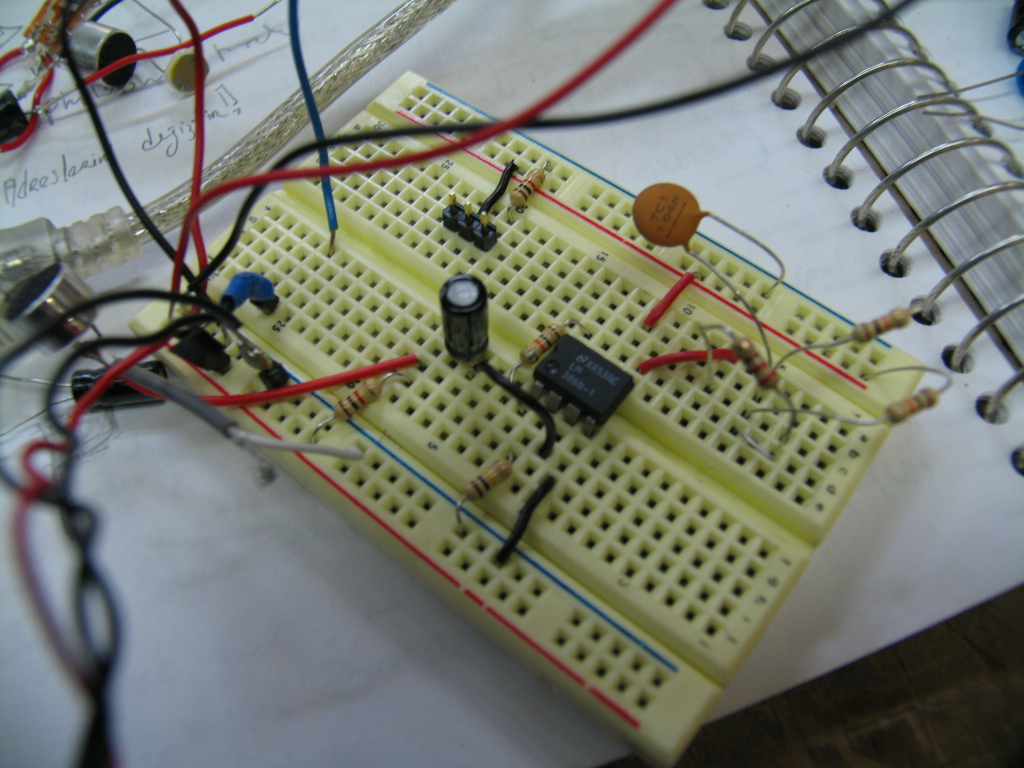
- Well, overall it wasn’t easy as I thought it was going to be. Since sound is AC in its nature, it was kind of hard to keep it in a certain threshold. I tried to use Tom’s schematics and example in PComp book, I had a really hard time with he microphone I bought from radioshack. It was a Electret Condenser Microphone Elements coming in power ground and analog. After several try outs, I totally bypassed using ground for ground and use power as analog too and use the white wire as the ground. It helped a lot.
- Besides that, I happened to understand that in order to get a good amplification I need to play with values of caps and resistors a lot. The first day I couldn’t get anything except random values which I happened to shape up a little bit in the following days by adding a http://en.wikipedia.org/wiki/Low-pass_filter to the circuit. You can see it on the lower right side of the circuit. Basically I hooked up a resistor in series with analog that goes to ADC and also a cap from there to the ground. That made a huge difference.
- Beside technical aspects, I tried to think more on the engaging side of my application. I was interested in pushing it further by adding a small game on the software side. So the scenario I thought on top of my head was just adding special bubbles if the user shouts loud enough to mic. And those special bubbles could be plopped by other players using analog controllers. Neat huh? :)
- Today hopefully I am going to try to talk my analog controller with a processing application.