Research
Research
Emotion Categories
 Figure 1 - Taxonomy of emotion terms.
After Sandra Metts and John Bowers “Emotion in Interpersonal Communication,” Handbook of Interpersonal Communication, eds. Mark Knapp, Gerald Miller (Thousand Oaks, CA 1994) 508–541, p.511.
^GROUP ^SPECIFICATION ^CATEGORY LABEL AND EMOTION TYPE ^De |Well-Being | appraisal of a situation as an event | joy: pleased about an event \ distress: displeased about an event | | Fortunes-of-Others | presumed value of a situation as an event affecting another | happy-for: pleased about an event desirable for another \ gloating: pleased about an event undesirable for another \ resentment: displeased about an event desirable for another \ jealousy*: resentment over a desired mutually exclusive goal\ envy*: resentment over a desired non-exclusive goal\ sorry-for: displeased about an event undesirable for another | | Prospect-based | appraisal of a situation as a prospective event |hope: pleased about a prospective desirable event \ fear: displeased about a prospective undesirable event | | Confirmation | appraisal of a situation as confirming or disconfirming an expectation | satisfaction: pleased about a confirmed desirable event \ relief: pleased about a disconfirmed undesirable event \ fears-confirmed: displeased about a confirmed undesirable event\ disappointment: displeased about a disconfirmed desirable event | | Attribution | appraisal of a situation as an accountable act of some agent | pride: approving of one’s own act \ admiration: approving of another’s act \ shame: disapproving of one’s own act \ reproach: disapproving of another’s act | | Attraction | appraisal of a situation as containing an attractive or unattractive object | liking: finding an object appealing \ disliking: finding an object unappealing | | Well-being/Attribution | compound emotions | gratitude: admiration+joy \ anger: reproach+distress \ gratification: pride+joy \ remorse: shame+distress | |Attraction/ Attribution | compound emotion extensions |love: admiration+liking \ hate: reproach+disliking |
Reference: Clark Elliott, 1998 after Ortony, et al., 1988
Links
Affective Computing is computing that relates to, arises from, or deliberately influences emotions. Emotion is fundamental to human experience, influencing cognition, perception, and everyday tasks such as learning, communication, and even rational decision-making. However, technologists have largely ignored emotion and created an often frustrating experience for people, in part because affect has been misunderstood and hard to measure. Our research develops new technologies and theories that advance basic understanding of affect and its role in human experience. We aim to restore a proper balance between emotion and cognition in the design of technologies for addressing human needs.
I argue that an activity theory —which regards emotions as interdependent and interpenetrating with other cultural phenomena— is central for the cultural psychology of emotions. Activity theory maintains that the cultural characteristics, development, and functions of emotions are shaped by social activities and cultural concepts. I explain the relation of biological to cultural factors in shaping the characteristics and development of emotions. Evidence is presented which shows that biological processes — hormones, neurotransmitters, autonomic reactions — underlie (mediate) but do not determine emotional qualities and expressions. Particular qualities and expressions are determined by cultural processes and factors.
- Online Gaming and Emotion Representation Abstract. The ability to simulate lifelike interactive characters has many applications in the gaming industry. A lifelike human face can enhance interactive applications by providing straightforward feedback to and from the users and stimulating emotional responses from them. Thus, the gaming and entertainment industries can benefit from employing believable, expressive characters since such features significantly enhance the atmosphere of a virtual world and communicate messages far more vividly than any textual or speech information. In this paper, we present an abstract means of description of facial expressions, by utilizing concepts included in the MPEG-4 standard. Furthermore, we exploit these concepts to synthesize a wide variety of expressions using a reduced representation, suitable for networked and lightweight applications. *Towards a Grammar of Emotions, in New Universities Quarterly, 36,3, pp 230-238, 1982. By analysing what we mean by ‘A longs for B’, and similar descriptions of emotional states we see that they involve rich cognitive structures and processes, i.e. computations. Anything which could long for its mother, would have to have some sort of representation of its mother, would have to believe that she is not in the vicinity, would have to be able to represent the possibility of being close to her, would have to desire that possibility, and would have to be to some extent pre-occupied or obsessed with that desire. The paper includes a fairly detailed discussion of what it means to say ‘X is angry with Y’, and relationships between anger, exasperation, annoyance, dismay, etc. Emotions are contrasted with attitudes and moods. *Emotions Revealed What is an emotion? How many different emotions are there? Are all emotions universal? The journey towards understanding, whether the knowledge of science or the wisdom of philosophy, is as much about the refinement of the language as it is about experiments and treatises. In the context of emotions, there is still much work to be done in building a coherent framework of terms thanks in part to the generous scope the word ‘emotion’ has acquired. Paul Ekman’s work is a substantial and invaluable step towards achieving this goal.
Color Emotion Association
Deciding for the colors of my project I used a research paper called Relationship between color and emotion: a study of college students from College Students Journal. The paper is dated 2004, it is using students aged between 20-25, it is using Munsell Color System for its research.
Munsell Color System
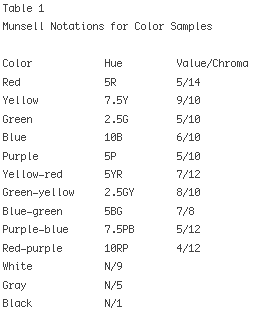
Of the numerous color systems that exist (see Jacobson & Bender, 1996 for discussion), one color system noted internationally for its precise identification process is the Munsell Color System (Ballast, 2002; Valdez & Mehrabian, 1994). According to this system, each color has three basic attributes: hue, value (brightness), and chroma (saturation). Hue is the first attribute of a color by which we distinguish one color from another (e.g., blue from red, green from yellow). There are 10 hues, five of which are identified as principal hues (i.e., red, yellow, green, blue, and purple) and the other five are intermediate hues (i.e., yellow-red, green-yellow, blue-green, purple-blue, and red-purple). Value, the second attribute of color, describes the degree of lightness or darkness of a color in relation to white and black. Black, white and the shades of gray are called neutral (achromatic) colors. The third attribute of a color is chroma, which is the degree of purity or vividness of the hue (i.e., with high saturated colors containing less gray) when compared with a neutral gray of the same value (Ballast, 2002).
The purpose of the present study was to examine college students’ color-emotion associations, referencing color samples from the standardized Munsell Color System and to investigate the reasons for students’ emotional reactions to each color.
So it looks like they asked 98 college students at a public institution in southeast. They chose 10 fully chromatic saturated colors from Munsell Color system: red, yellow, green, blue, purple, yellow-red, green-yellow, blue-green, purple-blue, and red-purple.
According to the paper, based on the results obtained from the student’s responses, a total of twenty-two emotions were gathered (see Table 2). Some of the emotions had the same meaning (e.g., empty, void) and some were overlapped (e.g., happy, happiness, joy), so they were grouped under the same emotion category. There was also a category for those responses that indicated no emotional response.
Quoting the paper: Because of the low frequencies in several cells, the emotions were coded as “positive”, “negative”, or “no emotion” (see Table 3). Overall, 62.2% of the participants expressed positive responses to colors, 34.2% expressed negative responses, and 3.6% expressed no emotion. About 80% of the responses to the principle hues, including red, yellow, green, blue, and purple were positive, compared with only 29.2% for the achromatic colors, including white, gray, and black (see Table 3). Only 17.8% of the responses to the principle hues were negative, whereas 68.4% of the responses were negative for the achromatic colors.
Here are the result tables:
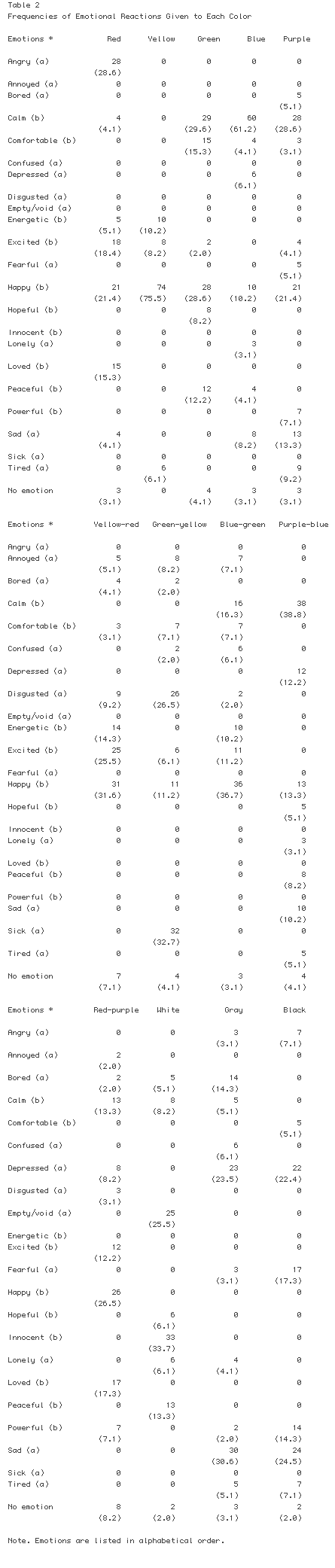 Note: The cell numbers indicate frequencies; the percentages are listed in parentheses. (a) Negative emotions. (b) Positive emotions.
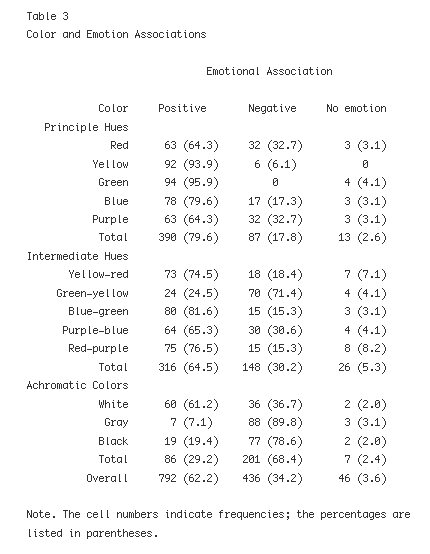
To sum up those values: I have the table below:
^EMOTION ^COLOR1 ^COLOR2 ^COLOR3 ^de | angry | red(%28) | | | | calm | blue(%60)| purple-blue (%38) | green (%29) | | comfortable | green(%15) | | | | excited | yellow-red(%25.5) | red (%18) | red-purple (%12) | | happy | yellow(%75) | red-purple(%26) | | | sick | green-yellow(%32) | | | | disgusted | green-yellow(%26) | | | | bored | gray (%14) | | | | depressed | gray(23.5) | purple-blue (12.2) | | | empty-void | white (25.5) | | | | fearful | black (%17.3) | | | | innocent | white (% 33.7) | | | | loved | redd-purple (%17.3) | | | | peaceful | white(%13.3) | | | | powerful | black (%14.3) | | | | sad | gray (%30.0) | black (%24) | | | tired | black (%7.1) | | | | energetic | yellow-red (%14.3) | | |