Progress
Progress
So referencing the diagram in the research page we can group the six main emotion groups as follows:
- LOVE, JOY, SURPRISE, ANGER, SAD, FEAR.
I went ahead and created a representation of those groups with emoticons.
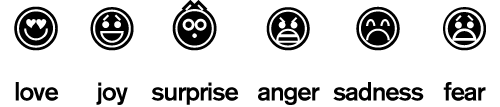
Though I like this categorization, there are some things I don’t like here. First of all, I am skeptical about the drawings. I still believe that they are so generic that they pass the level to invite people to participate. [Notice for the user: These drawing are going to be etched on a plexiglass with buttons connected. So users would be able to press particular buttons that remind themselves the feeling they have at that exact moment.] This can be explained in terms of “as being too wide that it is so narrow.”
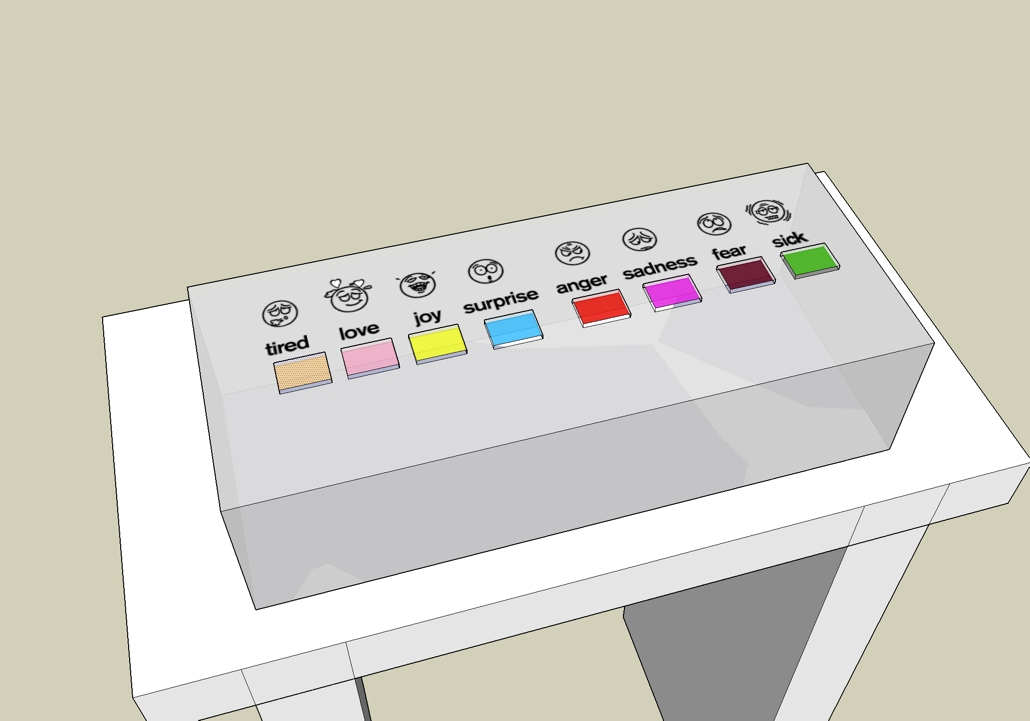
I believe I need to step back from the scientific categorization here and bring certain feelings/visuals like “being sick, being overwhelmed by the classes etc.” which the user will find empathy and press intentionally. Here is what I came up with as the second version of these visuals.

On a side note the user perception is such a thing that will change its behaviours relative to its surroundings. Maybe I shouldn’t be putting those two drawings on the same page. Regarding the second part, I think I find this piece more humanistic. Although it is not strong as the first one (this could be the black<->white as well) I am more leaning towards the second approach. An approach will follows categorization of scientific results yet add couple of feelings as a spice.
Also thinking this is going to be a box which invites people to participate, I should be finding new ways of creating those invitations.
- One thing I am thinking is color code the different feelings. So, when a person presses a button, it changes the box to change its color to that emotion until the other person come and press the other emotion and change the color of the box for that. I think this cue is really important in ways. First, when people are interacting with pieces, they want to get some feedback instantly. According to this feedback, they decide to interact with it or not the next time they see it. In my scenario when I make the color change instantly, they will understand that they changed something. Second, sensory cues are really important for people. We doesn’t / and don’t want to/ have to read a book to understand how a thing works. The best way is to teach them how it works while you let them play with it. Again in my scenario, putting certain color cues for certain feelings again create this memory for people who are passing through it everyday. Over time they tend to learn what certain color codes symbolizes according to those lightings and their interaction.
- So thinking all of these, and also thinking I will be creating at least two of those devices, what if I make both of them change their color when someone press on the first one. So people near to the second will understand someone pressed it and will make a comment on that seeing the light. It’s up to them to participate and change the mood again.
Todos
- research color theory regarding categories of emotions. Which color could be applied to which emotions etc.
- A small voting system based on color assignments plus character selections.